Story by Sara Polato
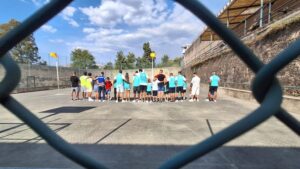
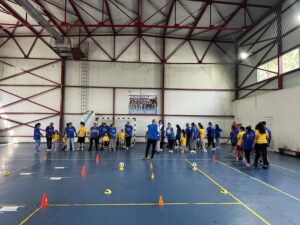
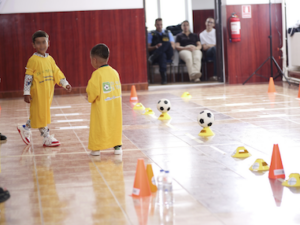
Entering San Vittore prison (Milan, Italy) for a game is never like entering a stadium. Here, there are no spacious gyms or grass pitches under the sun, but the warmth we have built within the walls of the playroom has transformed simple wooden games into an arena of unforgettable emotions. We were there for “Game with Mum & Dad”, a project that goes far beyond the score on the scoreboard: it is a tournament of closeness created to support parenthood where walls seem to want to divide it.
The day began early, around 9:30 a.m., in front of the entrance to the large avenue that runs alongside the prison. The children waited beyond the gates, some with the impatience typical of 3- or 5-year-olds, others with the shy and composed anticipation of 13- and 14-year-olds. To pass the time during the rigorous security checks, the Spazio Giallo (Yellow Space) of Bambinisenzasbarre became the first refuge: among sheets of paper, colours and toys, and dialogue with our operators, the enthusiasm at the idea of finally meeting their fathers was almost tangible in the eyes of the 21 children present.
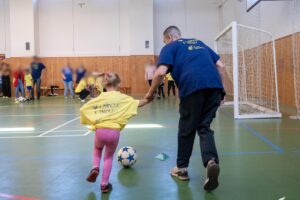
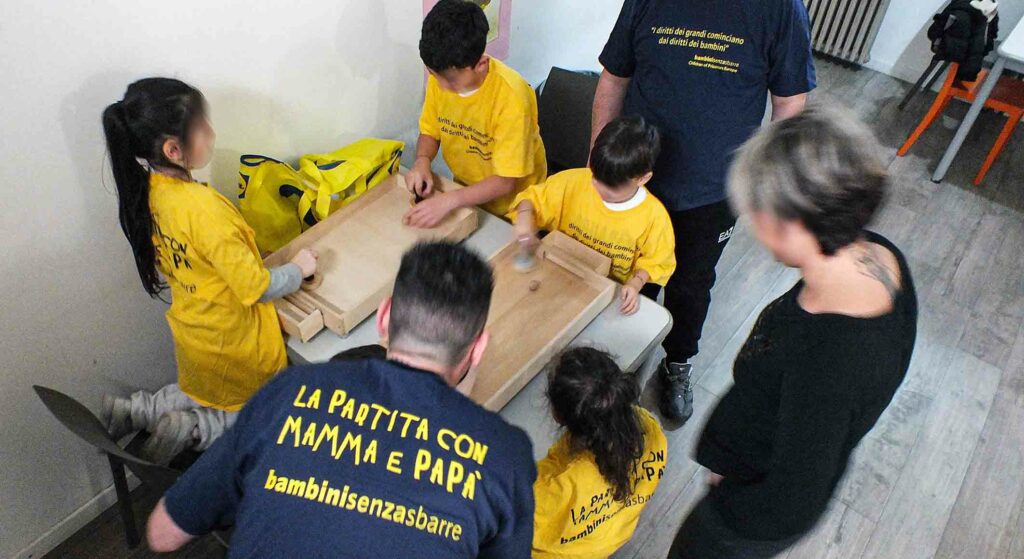
As the families entered, we operators experienced a magical moment with the fathers already present in the room assigned to us, a sort of “locker room talk” before the kick-off. We reminded them that today they were not subject to a registration number, but were the “men of the match” for their children. They were called upon to play the most important game: that of relationship and emotional bond. Matteo, our young scout leader, carefully explained the secrets of the 5 games available: the game of 15, five-a-side football, discs, zig-zag and paddles. The objective was profound in its simplicity: it was up to the fathers to teach the rules to their children, reclaiming for a moment their natural role as guides and teachers of life.
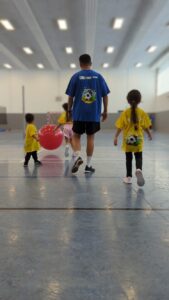
At 10:30 a.m., the room exploded with life and hugs. Children of all ages – ideally grouped as the youngest (0-5 years), school-age children (6-10 years) and older children (over 10 years) – finally hugged their fathers. After a quick snack and the distribution of the association’s yellow (for children) and blue (for parents) T-shirts, the tournament officially began. The rotating challenges, marked on a large scoreboard, sparked healthy and vibrant competition. Michael and Antonio competed in the final amid general cheering, but in that classroom, every point scored was a small victory against the loneliness of the cell.
“I never get tired of being with Dad, I would live here,” Giada, Michael’s daughter.
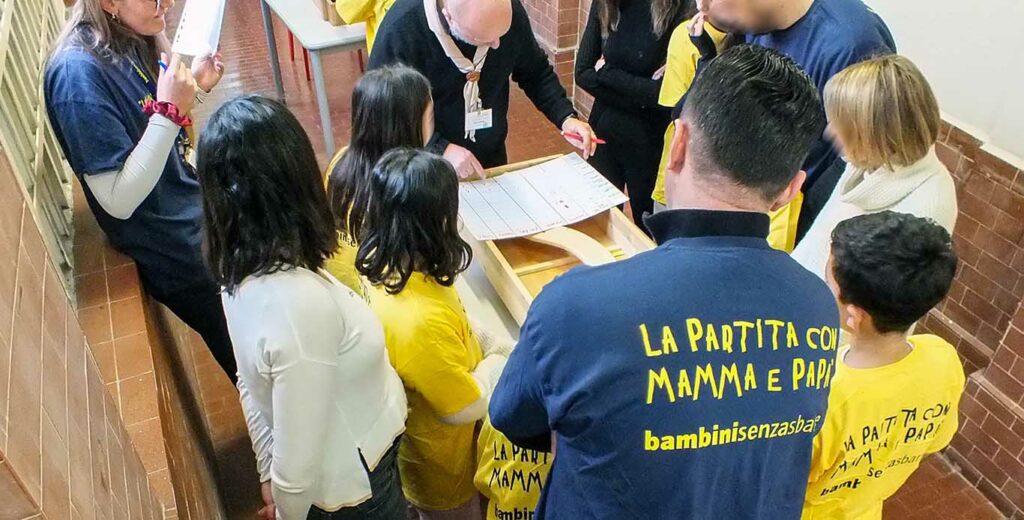
The beauty of the event lay in the spontaneous reactions. There was Kataly, too young to compete in the games, but who remained a tireless “entertainer” of the meeting with smiles that melted the tension of the parents. Others devoted themselves to “multi-handed” drawings – 4, 6 or 8 hands, depending on who joined the table – creating works of art born of pure collaboration. These drawings, later given to the fathers, were not just pieces of paper, but precious memories to take back to their cells as tangible proof of a morning of emotional freedom.
The atmosphere remained peaceful and collaborative throughout, thanks in part to the sensitivity of the prison officers and educator, who discreetly ensured this newfound normality, fostering a truly welcoming atmosphere. When lunchtime arrived, the conviviality reached its peak. Despite a slight delay in the delivery of the pizzas, no one seemed to complain: the extra time was just another opportunity to be together. We ate pizza, focaccia with olives and salami sandwiches carefully prepared by the women’s section of the prison, finishing with biscuits and drinks brought by the fathers.
It was during this break that Giada, Michael’s daughter, summed up the profound meaning of our work with disarming naturalness: “I never get tired of being with Dad, I would live here,” she exclaimed, before performing a perfect cartwheel right in the middle of the room. That improvised somersault encapsulated all the carefree spirit of a little girl who, for a few hours, had stopped being the “girl with a parent in prison” to be just a girl playing with her father.
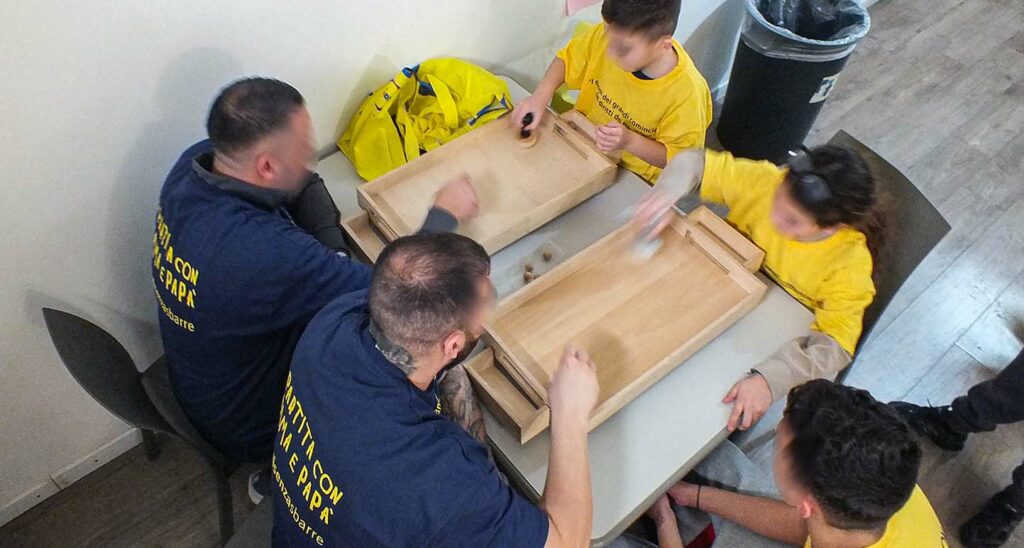
At around 1:50 pm, as if to bring us back to reality, the prison staff signalled the end of the activities. The farewells were intense and heartfelt, filled with a sweet melancholy because they were nourished by a morning of true joy. But it was not a definitive end: all the fathers, struck by the intensity of the experience, expressed their desire to participate in the next drawing workshops and discussion groups scheduled for February as an integral part of the preparation for the next Game.
As the families left the room in an orderly fashion and the fathers stopped to tidy up the space – a final gesture of care towards the place that had welcomed them as free men – we realised that the gamble had paid off. We had not only organised a Game with Mum & Dad event or a tournament of wooden games; we had rekindled a light, strengthened a bond and shown that, even behind bars, the “game of life” can still be played, and won, together with one’s children.
GWMD is a project created and organised in Italy since 2015 by Italian COPE member Bambinisenzasbarre, a NGO working to protect the rights of children with imprisoned parents in Italy and Europe, in cooperation with the Prisons Administration Department (DAP).
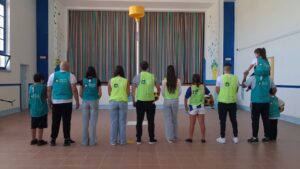
Across Europe, GWMD is implemented by Children of Prisoners Europe (COPE) and made possible with the support of the European Commission and UEFA Foundation for Children, following the original model of Bambinisenzasbarre. The Project aims to strengthen, maintain and enhance the bond between children and their imprisoned parents, and to generate systemic, child rights–based change across prison systems.